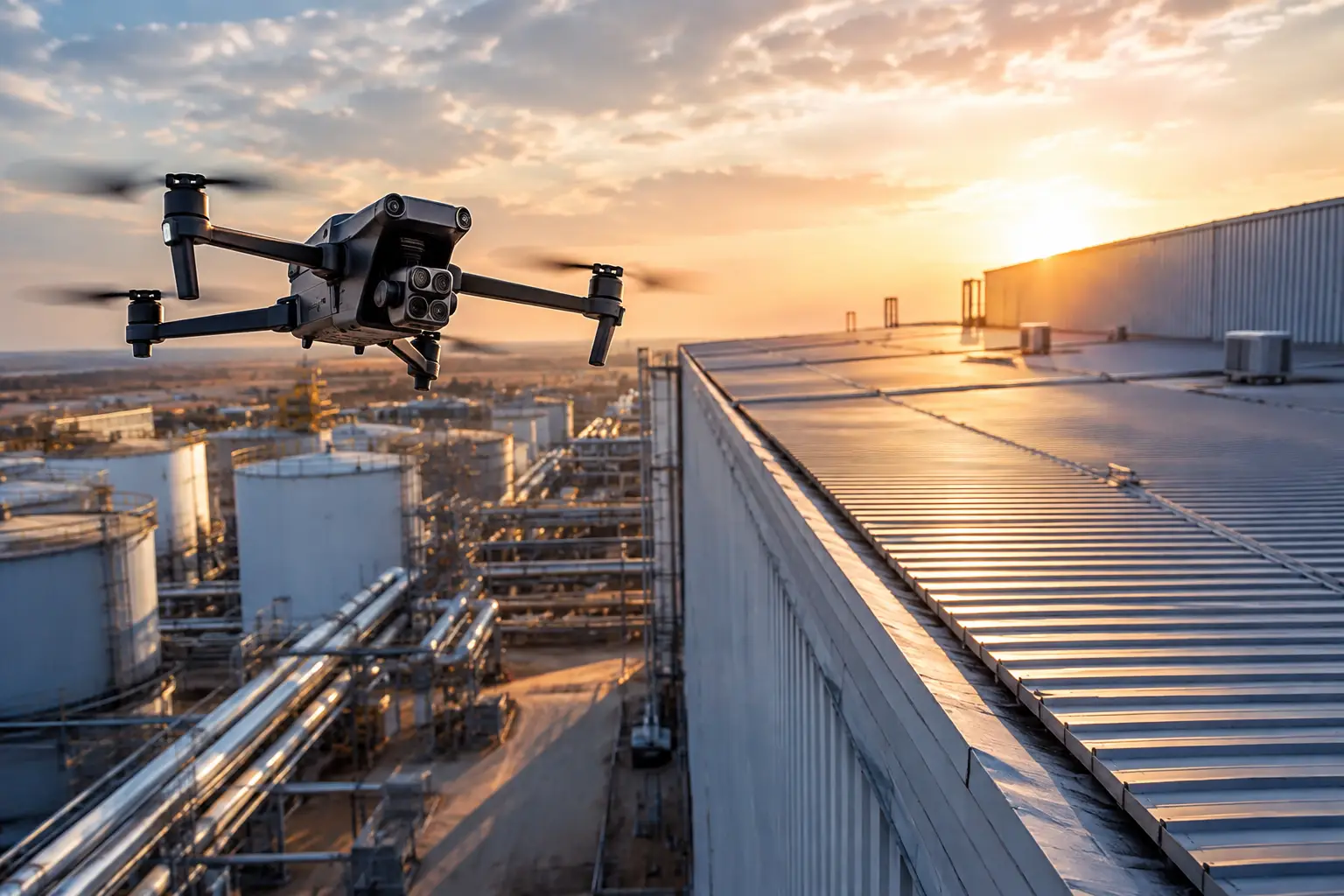
A roof leak rarely announces itself at the point where water enters the building. By the time staining appears inside a plant, warehouse, or commercial facility, moisture may have traveled through insulation, seams, decking, or drainage paths. An industrial roof thermal inspection gives facility and maintenance teams a faster way to identify temperature patterns that may point to hidden roof concerns before they become larger operational problems.
Thermal imaging does not certify a roof or replace a qualified roofing professional or engineer. It provides disciplined visual data that helps teams focus follow-up investigation, plan repairs, document conditions, and make better decisions about where to spend maintenance dollars.
Why Industrial Roof Thermal Inspection Matters
Industrial roofs are large, complex, and expensive to access. A single facility may have multiple roof elevations, mechanical penetrations, parapet walls, drains, curbs, patches, HVAC units, and areas modified over decades of maintenance. Walking every square foot can be slow, disruptive, and hazardous, particularly when the roof surface is aging, wet, congested, or difficult to reach.
Thermal inspection adds another layer of information to a visual roof assessment. A calibrated thermal sensor records surface temperature differences. Under the right conditions, wet insulation can retain heat differently than dry insulation after the roof has absorbed solar energy. Gaps, damaged sections, heat transfer around penetrations, and some drainage-related issues may also create patterns worth investigating.
For facility managers, the value is not simply receiving a thermal image. It is receiving organized aerial documentation that identifies anomalies by location, pairs thermal findings with high-resolution visual imagery, and gives maintenance or engineering teams a practical starting point for verification.
What Thermal Imaging Can Help Reveal
Aerial thermal data is most useful when it is treated as screening and prioritization information. It can help identify areas that deserve closer inspection, testing, or repair planning. Common findings may include suspected moisture intrusion, insulation irregularities, areas of elevated heat loss, and thermal differences around roof penetrations or mechanical equipment.
Suspected Moisture Beneath the Membrane
Wet insulation often behaves differently from dry insulation during an appropriate thermal window. After daytime solar loading, moisture-retaining areas may cool at a different rate than surrounding roof sections. Those differences can appear as distinct thermal patterns across an otherwise uniform roof field.
That finding is not proof of a leak, and not every warm or cool area is moisture. Roof type, insulation depth, membrane color, wind, shading, recent rain, rooftop equipment, and internal building conditions can affect readings. Still, identifying suspect zones can significantly reduce the time required for a roofing contractor or building envelope specialist to determine where further testing is warranted.
Insulation Gaps and Heat Loss Patterns
Thermal imaging can also support energy and maintenance reviews. Temperature differences near roof-to-wall transitions, curbs, penetrations, and patched areas may indicate insulation discontinuities or air movement pathways. In conditioned facilities, these patterns can help teams prioritize areas for closer review when energy costs, occupant comfort, or process control is a concern.
The interpretation depends on the building and the inspection objective. A refrigerated facility, a heated manufacturing plant, and an unconditioned warehouse will not produce the same thermal signature. Good inspection planning starts with an understanding of the asset, operating conditions, and the questions the client needs answered.
Drainage and Surface Condition Concerns
Visible aerial imagery remains essential. Thermal data can point to unusual areas, while high-resolution visual imagery may show ponding, membrane wear, open seams, damaged flashing, debris accumulation, clogged drains, or equipment-related traffic paths. Reviewing both datasets together provides better context than using either one alone.
This is especially useful for large roofs where recurring ponding or localized deterioration may not be obvious from a ground-level view. Clear location-based documentation also makes it easier to compare conditions between inspections.
Conditions Determine Whether the Data Is Useful
Thermal inspection is not a fly-anytime service. The quality of the results depends heavily on environmental conditions and the inspection plan. A roof generally needs an adequate temperature differential for meaningful thermal contrast, often created by solar loading and a suitable period of cooling. Timing may be late afternoon, evening, or another window determined by the roof assembly and weather conditions.
Recent rain can complicate an inspection by cooling surfaces or creating broad moisture effects that mask localized anomalies. High winds can reduce thermal contrast. Heavy cloud cover may limit solar heating. Standing water, roof contamination, reflective materials, and shadows from nearby structures can also influence what the camera records.
A professional provider should evaluate these factors before deployment rather than treating thermal imagery as a routine add-on. If conditions are poor, rescheduling may provide far more useful data than collecting imagery that cannot support confident maintenance decisions.
A Field-Ready Inspection Workflow
A productive industrial roof inspection begins before the aircraft is launched. The team should establish the inspection objective, understand site access requirements, identify operational constraints, and plan for safe flight paths around rooftop equipment, utilities, structures, and active work areas. FAA Part 107 compliance, site coordination, and appropriate insurance coverage matter when work is performed around valuable commercial and industrial assets.
The aerial collection process typically combines overlapping visual imagery with thermal imagery, captured systematically across the roof rather than as a series of isolated photographs. Depending on the assignment, deliverables may include annotated thermal images, high-resolution visual photographs, an orthomosaic map, marked areas of interest, and a location-based inspection summary.
The most useful reports distinguish between observed conditions and recommended next steps. For example, a report may identify a thermal anomaly adjacent to a roof drain or penetration, show its precise location, and recommend field verification by a qualified roofing professional. That is more useful than making unsupported claims about the cause or severity of the condition.
Where Aerial Thermal Data Fits in Roof Maintenance
Aerial thermal inspection works best as part of a broader asset management process. It can support baseline documentation for a newly acquired facility, pre-maintenance planning, post-storm review, warranty discussions, capital planning, and periodic condition monitoring. It is also valuable when a maintenance team needs to inspect a large roof quickly without sending personnel across every area before priorities are known.
For insurance and catastrophe-response workflows, aerial imagery and thermal data can help document visible roof conditions after severe weather, subject to safe site conditions and appropriate flight planning. The resulting records can support adjusters, owners, consultants, and contractors as they evaluate next steps. The data does not determine coverage or establish causation, but it can create a clear record of conditions observed at the time of inspection.
There are trade-offs. A close-up physical inspection remains necessary when a suspect area must be tested, sampled, measured, or repaired. Thermal imaging may not identify every defect, particularly where roof assemblies, weather, or surface conditions limit contrast. For many facilities, however, it provides a safer and more efficient way to direct those hands-on efforts where they are most likely to matter.
Choosing an Inspection Partner for High-Value Assets
Industrial roofs require more than a drone operator and a collection of images. The provider needs experience working around active facilities, a documented safety mindset, reliable equipment, and an understanding of how the data will be used by operations, maintenance, engineering, or insurance teams.
Ask how the provider plans for weather and thermal conditions, how anomalies will be documented, what visual data will accompany thermal findings, and how locations will be communicated to follow-up crews. Also confirm FAA Part 107 certification, insurance coverage, and the ability to work within site-specific procedures.
Air Reel Technologies approaches industrial aerial work with the discipline required for complex commercial and critical infrastructure environments. The goal is practical: provide accurate visual intelligence that reduces unnecessary exposure, improves documentation, and helps responsible teams act on the right areas first.
A roof issue does not become less expensive because it is hard to see. When inspection conditions are right, thermal data can give your team a clearer view of where to investigate before a hidden condition turns into downtime, damage, or an avoidable capital expense.